Solo or Pool? What 89 Days to 0.01 BTC Actually Tells You
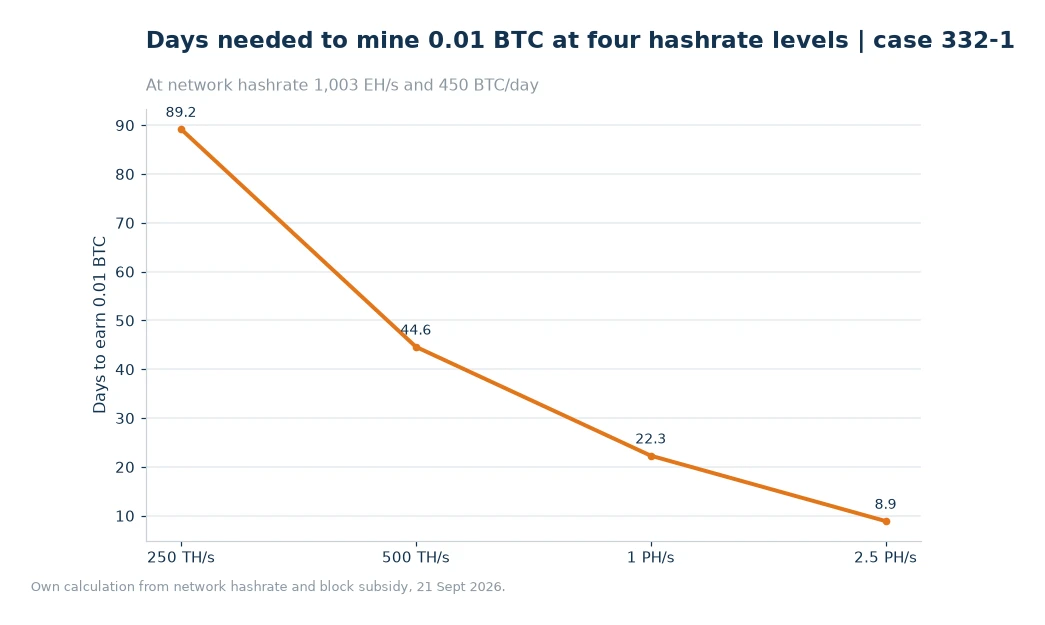
The solo-versus-pool argument usually turns into a debate about luck, which is the one variable nobody can plan around. A cleaner starting point is a calendar. At 250 TH/s, earning 0.01 BTC takes about 89.2 days at the 21 Sept 2026 network figures; at 2.5 PH/s the same target takes 8.9 days. Neither number says which arrangement is better — but both say how long you would wait to find out.

Key takeaways
- 250 TH/s reaches 0.01 BTC in about 89.2 days at 1,003 EH/s and 450 BTC a day.
- Doubling hashrate halves the wait: 500 TH/s needs 44.6 days, 1 PH/s needs 22.3, 2.5 PH/s needs 8.9.
- A pool converts an uncertain block find into a steady share; solo mining keeps the uncertainty and the whole reward.
- Pool Luck moves a PPLNS payout around from window to window, while PPS+ settles hourly against difficulty instead.
The question behind the question
People ask whether to mine solo or join a pool, but what they usually mean is: how much variance can I stand, and for how long? Those are answerable. A calendar of expected earning time turns a philosophical argument into a schedule, and a schedule can be compared with a rent payment, a hardware loan or a patience threshold.
The calendar has one honest limitation. It shows the average path, not the actual one. Solo mining is lumpy by design: a machine can find nothing for months and then find a block in an afternoon. A pool smooths that curve. The days-to-target figure describes the smoothed path, which is what a pool pays and what solo mining averages out to over a long enough run.
Halving the wait is a matter of arithmetic
Days to a target is the target divided by daily output, and daily output is proportional to hashrate. So the relationship is inverse and linear: twice the hashrate, half the days. There is no cliff and no sweet spot hidden in the curve, which is why the chart looks like a straight line falling on a log axis.
That simplicity is useful when you are deciding where to spend. Going from 250 TH/s to 500 TH/s removes 44.6 days from the wait for 0.01 BTC. Going from 1 PH/s to 2.5 PH/s removes 13.4 days. The second upgrade costs more and buys less time, because the first machine already did most of the waiting for you. Diminishing returns in days, not in coins.
There is a second use for the curve: it prices downtime. Losing three days at 250 TH/s costs about 3.4% of the wait, which sounds trivial until the same three days repeat every month for a year. Multiply the daily output by the number of idle days and the calendar turns into a maintenance budget.
Pool Luck is the part solo mining cannot remove
A pool's block finds over a window rarely match the statistical expectation exactly. Pool Luck is the name for that comparison, and it is why PPLNS payouts wobble: the miner's slice depends on what the pool actually found across the last five difficulty rounds. Under PPS+, the block-reward component is settled against difficulty instead, so that particular wobble does not reach the miner.
Solo mining sits at the far end of the same idea. There is no pool to share with, so the entire variance lands on one machine, and the wait for a block is measured in years at hobby hashrates rather than days. The pool state page is where the network side of this becomes visible: the ViaBTC Pool Hashrate reading, the network total, and the difficulty the next settlement will use.
It helps to put a number on the solo case rather than a feeling. At 250 TH/s the expected wait for one block, if a miner were working alone with the whole subsidy, runs to decades, and the calendar in this article describes a target of 0.01 BTC instead. Choosing a pool is really choosing to trade a small, predictable share for a large, unpredictable one.
Four sizes, four dates
The table converts the chart's day counts into dates, counting forward from 21 Sept 2026. Dates assume the network total and difficulty hold still, which they will not; treat them as a way to feel the scale rather than a delivery promise.
| Hashrate | BTC per day | Days to 0.01 BTC | Roughly lands on |
|---|---|---|---|
| 250 TH/s | 0.00011215 | 89.2 | 19 Dec 2026 |
| 500 TH/s | 0.00022430 | 44.6 | 5 Nov 2026 |
| 1 PH/s | 0.00044860 | 22.3 | 13 Oct 2026 |
| 2.5 PH/s | 0.00112150 | 8.9 | 30 Sept 2026 |
Worked example
Follow the smallest tier through the whole calculation, then check the scaling against the largest.
- Daily output per terahash: 450 BTC ÷ 1,003,000,000 TH/s = 0.0000004486 BTC.
- At 250 TH/s: 250 × 0.0000004486 = 0.00011215 BTC a day.
- Target divided by daily output: 0.01 ÷ 0.00011215 = 89.16 days, rounded to 89.2.
- At 2,500 TH/s the daily figure is ten times larger, 0.00112150 BTC, so the wait is a tenth: 89.2 ÷ 10 = 8.92 days.
- In dollars at $84,692, that 0.01 BTC is worth $846.92 whenever it arrives.
- Over the 89.2-day wait, the same machine also produces the fee-relevant detail: 0.00011215 × 89.2 = 0.010004 BTC, which is the target with rounding attached.
Reading a Pool Hashrate figure without over-reading it
The pool's own share of the network rises and falls with every large farm that joins or leaves, and with every difficulty adjustment. A big number is not a promise of higher per-terahash payouts, because the pool's share is one half of a fraction whose other half is the whole network. What the figure does tell you is depth: a larger pool finds more blocks, so a PPLNS window fills faster and a lucky streak at one pool has less effect on a single miner's month.
Watch the trend rather than the snapshot. A pool that grows steadily is attracting hashrate for reasons — uptime, latency, fees — and a pool that drops sharply has probably lost a large customer. Neither event changes your own daily credit at a fixed hashrate under PPS+, but both change how quickly a PPLNS miner's payments settle toward the average.
Frequently asked questions
Is 89.2 days a realistic wait for 0.01 BTC at 250 TH/s?
It is the arithmetic average at 1,003 EH/s and 45,000 TH/s per BTC of daily output: 0.01 ÷ 0.00011215 = 89.16 days, and a pool pays close to that path while solo mining would scatter around it.
Does Pool Luck matter if I choose PPS+?
Far less. PPS+ settles the block-reward component hourly against current difficulty, so Pool Luck affects the pool's experience rather than the miner's hourly credit, though the fee component still varies with network conditions.
Can I reach 0.01 BTC faster by switching pools?
Not at a fixed hashrate: the network total and difficulty set the rate, so the only levers are more hashrate, better uptime, or a lower listed fee on the component that dominates your payment.
Pick the wait you can sit through
Write the number of days beside the hashrate you actually own, and ask whether you would still be mining if the target arrived exactly then. If the answer is no, the plan is too slow and the fix is more hashrate or a smaller target, not a different pool. If the answer is yes, the arrangement is at least honest about its timescale.
Then check the hardware against the current market: the Miner Profitability Ranking shows models against today's price and difficulty, and the fee schedule settles what the pool keeps. A calendar built on those two pages will not flatter you, which is the point.
Sources: ViaBTC fee and miner ranking pages, plus network figures read 21 Sept 2026 — hashrate about 1,003 EH/s, difficulty 132.76 T, subsidy 3.125 BTC, 144 blocks a day, BTC $84,692. Published 24 Oct 2026. Day counts hold difficulty and uptime fixed[1].