Common Challenges in Comparing Particle Board Specifications from Suppliers
Particleboard quotations often use familiar grade names while referring to different property limits, service conditions, or test methods. A buyer should compare the complete panel designation, thickness, intended application, surface and edge treatment, emissions documentation, and production evidence. Matching one headline strength value is not enough to establish that two boards are interchangeable.
Key takeaways
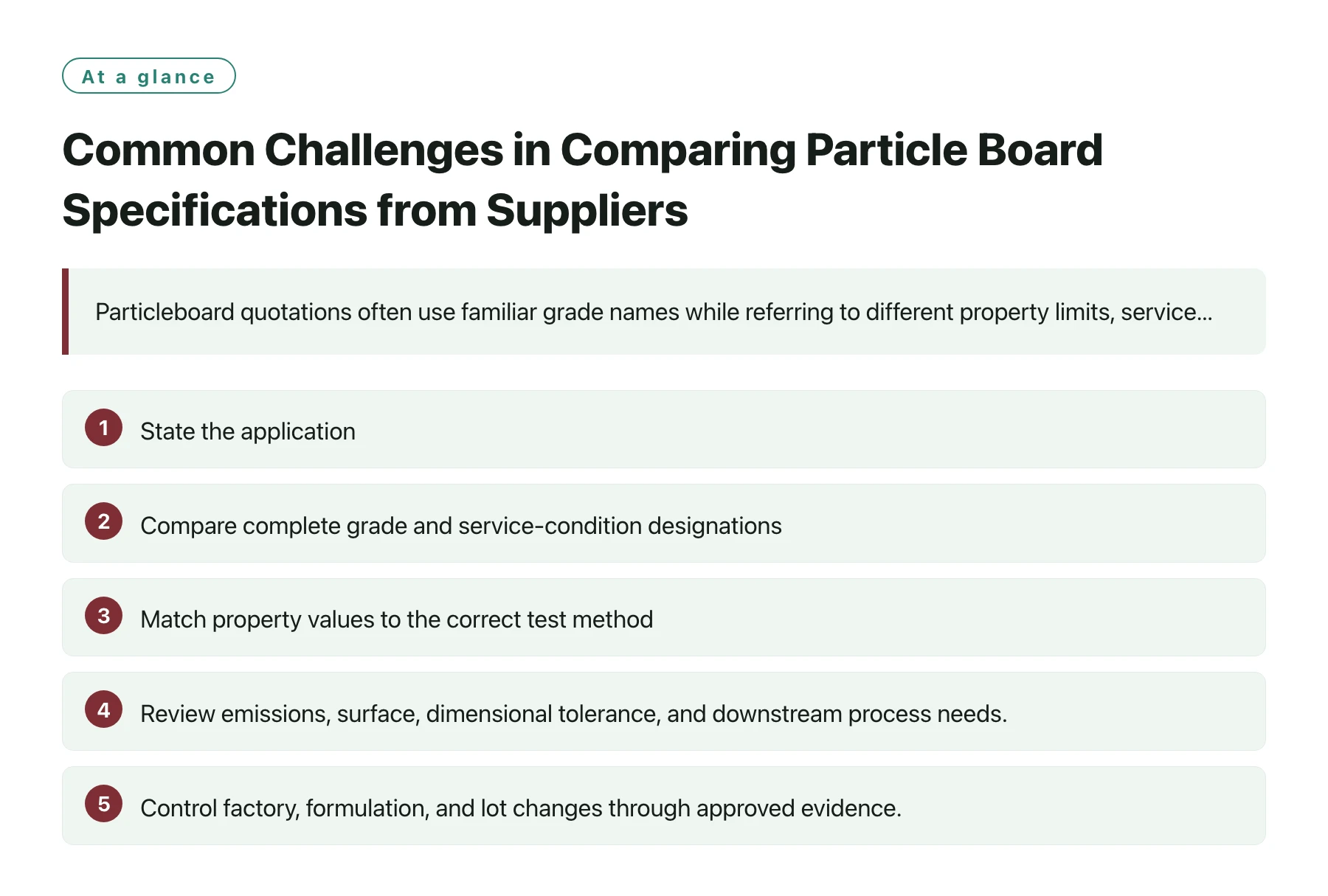
- State the application, load condition, thickness, and moisture exposure.
- Compare complete grade and service-condition designations, not shorthand labels.
- Match property values to the correct test method, units, and specimen conditioning.
- Review emissions, surface, dimensional tolerance, and downstream process needs.
- Control factory, formulation, and lot changes through approved evidence.
A controlled panel specification lets suppliers quote the same board and makes technical gaps visible before order placement.
1. Start with the end use and design responsibility
Describe whether the board is for furniture components, cabinetry, shelving, interior fit-out, packaging, or a load-bearing use. State dimensions, thickness, support spacing, fastening method, edge exposure, expected load, and service environment. If an engineer or customer owns the design, identify who approves material substitutions and structural calculations.
A board grade is not a substitute for application-specific design values. ISO 16893:2016 classifies particleboard and defines related property and test requirements for several uses and service conditions; its listed classification values are not characteristic values for structural design. Select the applicable basis with a competent technical owner. [1]
2. Make grade names and service conditions explicit
Request the complete grade designation and the standard edition used. ISO 16893:2016 includes categories for general purpose, furniture, load-bearing, and heavy-duty load-bearing particleboard, alongside service conditions. Regional standards, customer specifications, and supplier shorthand may not map one-to-one. Ask the vendor to state the governing document, class, and evidence for each claimed property.
Clarify whether the board is intended for dry, humid, or another defined service condition. “Moisture resistant” should be tied to a named classification or agreed test and limit. It does not mean waterproof or suitable for permanent wetting. Ask how the panel is protected at edges, joints, cut-outs, and fastener locations.
3. Compare thickness, density, and dimensional limits
Specify nominal thickness, tolerance, length, width, squareness, flatness, and the measurement method. Ask whether quoted dimensions refer to unfinished panels or finished faces. Record core density or density profile only when needed for the application, and define how samples are selected and conditioned before measurements.
Do not infer stiffness or fastener performance from density alone. Compare bending properties, internal bond, surface soundness, screw withdrawal, or other properties only when relevant to the use and supported by compatible methods. Check units and specimen direction, conditioning, and thickness range before comparing supplier values.
4. Treat moisture and mechanical performance as linked but distinct
Define likely humidity, spills, cleaning, installation timing, and edge exposure. Ask for the exact moisture-resistance class or test method, conditioning cycle, thickness swell or bond result if specified, and acceptance limit. A test result under one method cannot be substituted for another without a technical basis.
For shelves, cabinet sides, or load-bearing components, use design requirements that account for support span, load duration, fasteners, cut-outs, creep, and safety factors under the applicable design framework. Manufacturing classification can help screen a board but does not complete structural engineering or verify the finished assembly.
5. Verify emissions and regulatory documentation
State the destination market and required emissions regime or customer limit before quoting. Request declarations or laboratory reports identifying the panel, plant, date, test method, result, and scope. Confirm that the report covers the supplied raw board and any finished or laminated configuration when that distinction matters.
Check that the test body and sampling process meet the buyer’s rules. A generic certificate, a report for a different plant, or an old document may not establish current conformity. Assign a compliance owner to review applicable law; do not rely on a broad “E0” or “low emission” label without defining the governing method and limit.
6. Compare surfaces, bonding, and downstream processing
Identify whether the product is raw, sanded, laminated, veneered, or faced. Specify surface defects, thickness of decorative layers when relevant, color or pattern reference, gloss, edge quality, and allowable variation. For bonded surfaces, ask about substrate preparation, adhesive system, pressing, and resistance needed for the intended use.
Consider machining, drilling, edge banding, screw installation, coating, and assembly. Request a representative production sample with the same surface and thickness as the quote. Trial the buyer’s actual tooling and fasteners where failure would be costly. Note dust control and handling requirements at the converting site.
7. Align test reports with the offered board
A useful report identifies product name, grade, factory, sample source, thickness, standard and edition, test method, specimen conditioning, results, date, and laboratory. Compare like with like: if one offer reports a value under a different method or thickness, mark it as not directly comparable until a qualified reviewer assesses equivalence.
ISO 16893 specifies classes and related mandatory tests for defined particleboard applications and thickness ranges, while requirements vary by class and service condition. Ask the supplier to map its offered panel to the exact clauses and provide the underlying report or declaration needed for the purchase. [1]
8. Resolve common quotation gaps before selection
Common gaps include missing grade, unspecified thickness tolerance, ambiguous moisture claim, mismatched emissions scope, factory-level rather than product-level certificates, and property values with no test method. Create a clarification log with owner and due date. Do not fill gaps by assuming the most favorable interpretation of a supplier’s catalog.
Normalize price by panel size, usable yield, surface treatment, packing, minimum order, tooling, test charges, delivery term, and waste. If a lower-priced panel requires different edge banding, fasteners, machining speed, or replacement rate, include those effects in total cost.
9. Approve a controlled reference and change process
Record the approved manufacturer, factory, panel grade, thickness, surface, emissions basis, test file, sample identification, and purchase-order revision. Specify incoming checks for dimensions, identification, visual defects, damage, and required documents. Keep samples flat and protected so reference panels do not warp or absorb moisture.
Require advance approval for changes to raw material mix, resin system, process, plant, grade, facing, thickness, or source. Reassess the affected properties when changes can alter performance or compliance. Keep lot traceability and agree corrective-action steps for nonconforming deliveries.
10. Use one comparison matrix for every supplier
A practical matrix has columns for requirement, buyer limit, supplier declaration, evidence, method, deviation, reviewer, and decision. Separate mandatory items from preferences. Mark a missing report as pending and state whether a conditional quote is acceptable. This keeps technical review separate from commercial scoring.
For buyers evaluating particle board sourcing, the same specification can support requests for quotation, sample approval, inspection, and shipment release. Before buying, confirm that design approval, regulatory review, production checks, and final receiving responsibilities are assigned to named owners.
Sources
Frequently asked questions
Can particleboard grades from different standards be compared directly?
Not by label alone. Compare the full standard, grade, service condition, thickness, methods, limits, and intended application with a qualified technical review.
Does moisture-resistant particleboard mean waterproof?
No. Confirm the defined service condition and test basis, and protect edges and joints as required for the actual exposure.
Which properties matter most for furniture particleboard?
The answer depends on design, but may include thickness, bending performance, internal bond, screw holding, surface quality, emissions evidence, and machining needs.
Does a classification value prove a shelf design is safe?
No. Design also depends on span, loading, duration, supports, fasteners, geometry, and the applicable engineering method.